
Touchless Sanitizer Dispensers: Areas of Application, Benefits, and How to Choose the Right Unit
Content
Touchless hand sanitizer dispensers are a full-fledged part of the equipment used in public, commercial, and even private spaces, directly affecting hygiene standards, visitor safety, and the overall image of a facility. In office centers, medical institutions, retail areas, and sanitary zones, such devices are seen as a standard of modern service and a responsible approach to people’s health.
For companies working in construction, renovation, and facility outfitting, it is important to understand not only how touchless sanitizer dispensers work, but also their actual benefits, areas of application, and selection criteria.
This material was prepared by specialists from a company operating in the field of professional hygiene and sanitary zone equipment. The recommendations are based on practical experience in selecting and operating dispensing equipment at facilities with different levels of foot traffic.
Areas of Application for Touchless Dispensers
The main value of touchless hand sanitizing dispensers lies in the absence of physical contact with the unit during use. This can reduce the risk of cross-contamination and make hand disinfection safer and more controlled.
In 2023, a study published in the journal Hygiene (MDPI) found bacterial contamination on the levers and nozzle areas of manual sanitizer dispensers in a hospital setting. The authors directly recommend systematic cleaning of contact zones or switching to automatic dispensers in order to reduce hand contact with surfaces and potential microbial contamination.
For this reason, touchless sanitizer dispensers are used across a wide range of settings. Modern models are suitable not only for sanitizers, but also for other liquid products, from disinfectant solutions to cleaning and cosmetic formulations. The most common areas where a touchless sanitizer dispenser can be used include:
- medical institutions of all types, including clinics, laboratories, and dental practices;
- office centers, business spaces, and coworking areas;
- shopping centers, stores, and supermarkets;
- hotels, restaurants, cafés, and other HoReCa facilities;
- sanitary zones, public restrooms, and industrial premises.
When a touchless sanitizer dispenser is used in these environments, it helps maintain a consistent sanitary standard, reduce the workload on staff, and create a sense of safety and care for visitors.
Advantages of Touchless Dispensers Compared to Manual Ones
When choosing equipment for sanitary zones, automatic solutions are increasingly preferred. This is due not only to the trend toward touchless technologies, but also to their practical advantages in everyday use. Modern sensor-based sanitizer dispensers are designed for intensive use and are suitable for facilities with high foot traffic.
Their main advantages include:
- automatic dispensing without pressing reduces the risk of transmitting bacteria and viruses;
- economical liquid consumption thanks to precise dosing;
- energy-efficient electronic components reduce maintenance costs;
- a neat and modern appearance improves the overall perception of the interior;
- easy installation and maintenance without complex technical procedures.
As a result, the facility owner gets a reliable sanitary control tool that works consistently and does not require constant staff attention.
How to Choose a Touchless Dispenser: Key Criteria
For the device to truly perform its functions and last a long time, it is important to select the right model for the operating conditions. There is no universal solution: the choice always depends on foot traffic, the type of liquid used, and design requirements.
Before buying a touchless sanitizer dispenser, it is recommended to assess several basic parameters that directly affect convenience and service life.
First, the tank capacity. For public spaces, models with a capacity of 1 liter or more are optimal, as they require less frequent refilling and are suitable for intensive use. Second, the dispensing type: spray or drop. Spray provides more even distribution of the sanitizer and is especially convenient in high-traffic areas. Third, the housing material: durable ABS plastic is considered the optimal combination of light weight, chemical resistance, and wear resistance.
It is also worth paying attention to the power source, the presence of an on/off switch, compatibility with different liquids, and the overall build quality of the device. Taken together, all of these factors determine the practical value of the automatic dispenser.
An Example Solution for Commercial and Public Facilities
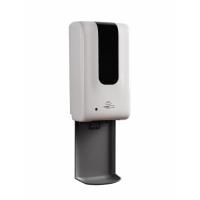
As a clear example of modern touchless equipment, we can consider the Fengjie Bathroom Co. sensor spray disinfectant dispenser.
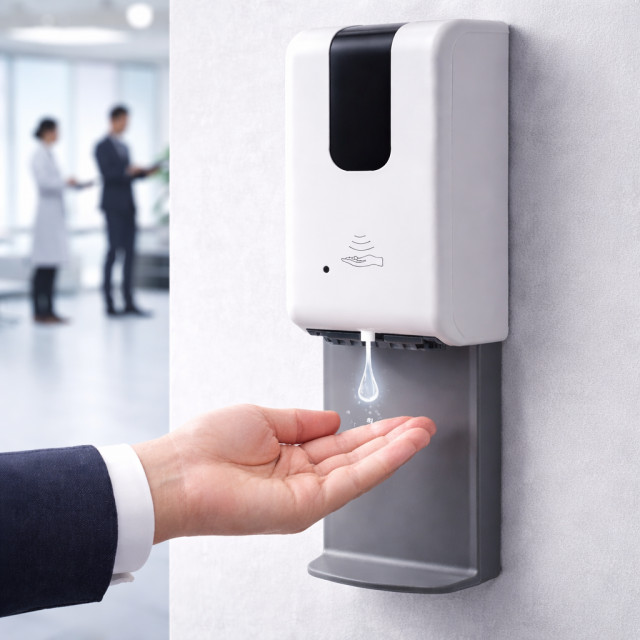
This model is designed for automatic dispensing of liquid products without physical contact with the housing. The sensor is activated when a hand is placed underneath it and dispenses the sanitizer in the form of a fine spray. The built-in energy-efficient electronic module optimizes power consumption, which is especially important during continuous operation in public places.
The housing is made of durable ABS plastic resistant to alcohol-based and disinfectant solutions. Visually, the device looks neat and modern: the white body is complemented by a contrasting mirrored insert, allowing the touchless dispenser to fit harmoniously into sanitary zones, offices, stores, and hotel interiors.
The 1.2-liter tank makes it possible to use the device for a long time without frequent servicing, while the manual power switch simplifies operational control.
A touchless sanitizer dispenser is a functional element of modern infrastructure. Such devices improve hygiene standards, reduce the risks of contamination transmission, and build trust among visitors and staff. A properly selected automatic sanitizer dispenser offers a long service life, economical product consumption, and a natural fit within the interior.
For construction, commercial, and service companies, choosing high-quality touchless equipment is an investment in safety, reputation, and user comfort. That is why, when outfitting facilities, more and more businesses prefer automatic sensor-based solutions that meet modern standards and market expectations.
FAQ
1. Does a touchless dispenser still need maintenance if no one touches it?
Yes. Touchless operation reduces the number of contact points, but it does not eliminate the need for regular wiping of the housing and dispensing area, as well as monitoring the cleanliness of the container or cartridge, especially at facilities with high foot traffic.
2. Where is the best place to install dispensers at a facility?
It is practical to place dispensers where people most often pass through and touch surfaces: at entrances and exits, near elevators, and in common areas. At the same time, it is important to follow safety requirements and avoid placing alcohol-based products near potential ignition sources.
3. Can sanitizer dispensers be used in schools and children’s areas?
Yes, but usage should be supervised. The CDC recommends monitoring young children to prevent accidental swallowing and choosing products with an alcohol content of at least 60 percent.