
Cleaning and Disinfecting Water Coolers: How to Clean Them and What to Use
Content
A water cooler has long ceased to be equipment used only in offices — today it is actively used in private houses, apartments, construction sites, showrooms, service areas, and utility rooms. At the same time, many users forget that it is a complete system inside which water, air, and internal surfaces are constantly in contact. If a water cooler is not maintained regularly, it can become a source of bacteria, fungi, and unpleasant odors, and in some cases even a direct threat to the quality of drinking water.
A professional approach to cooler maintenance is a matter of hygiene and equipment longevity. But how do you properly clean a water cooler at home? Which products actually work, and which ones are better avoided? Let’s take a closer look.
Why Regular Cleaning of a Water Cooler Is Necessary
Over time, biofilm forms inside any water cooler — a thin layer of organic deposits in which microorganisms actively multiply. Even when bottled water is used, completely sterile conditions do not exist: bacteria get inside from the air, during bottle replacement, and through taps and the drip tray.
Areas where water stagnates or heats up become contaminated especially quickly. This leads not only to poorer taste, but also to a real microbiological risk. Regular disinfection of a water cooler helps destroy biofilm, remove organic contamination, and prevent the growth of pathogenic microflora.
In 2025, a review study published in the journal AIMS Microbiology analyzed around 70 scientific papers on the microbiological condition of water from water dispensers. The authors noted that with insufficient maintenance, such devices can accumulate biofilm and show higher levels of microbial contamination than the source water itself. The practical conclusion is straightforward: regular cleaning and disinfection of components that come into contact with water and air are key to maintaining stable water quality.
It is important to understand which elements need treatment first. Cleaning a water cooler is especially important in the following areas:
- internal tanks for cold and hot water;
- water supply tubes and connections;
- water dispensing taps and the drip tray;
- the bottle probe and bottle neck area.
Ignoring these areas makes the procedure formal and ineffective. Cleaning a water cooler helps the equipment operate more reliably, while the water remains safe for daily consumption.
Household Remedies: Why Vinegar and Lemon Are a Bad Idea
On the internet, you can still find advice on how to clean a water cooler with vinegar, citric acid, or baking soda. At first glance, such methods seem simple and affordable, but in practice they either fail to solve the problem completely or create new risks.
Cleaning the internal elements of a cooler with acids may indeed help remove some scale, but they do not provide полноценной disinfection. Moreover, vinegar and citric acid are not intended to control a broad range of microorganisms inside drinking water equipment, and they may also damage the internal parts of the cooler, especially with regular use.
Before washing a water cooler using such methods, it is important to consider their real limitations. The main disadvantages of household remedies are:
- lack of a proven disinfecting effect;
- risk of damage to plastic and rubber parts;
- inability to control concentration precisely;
- lingering odor and an off-taste in the water.
As a result, the user gets only an illusion of cleanliness, while microorganisms continue to develop inside the equipment. That is why, in professional practice, cleaning a cooler with household remedies is considered not only ineffective, but also potentially unsafe.
Effective Products for Cleaning and Disinfecting Water Coolers
If you want to know how to wash a water cooler properly and effectively, it is recommended to use specialized or professionally developed products with proven performance. They allow you to clean surfaces and ensure microbiological safety at the same time.
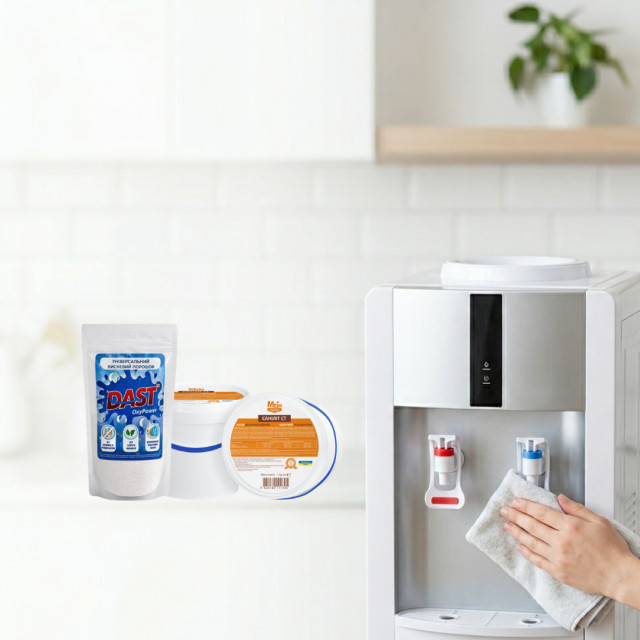
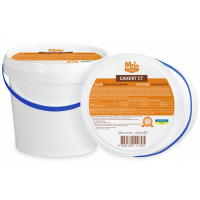
For industrial and commercial use, Sanilit ST is an optimal solution. It is a tablet-based disinfectant based on active chlorine, intended for comprehensive disinfection, pre-sterilization cleaning, and sterilization. The product effectively destroys bacteria, viruses, fungi, and spores, does not fix organic contamination, and is easy to rinse off surfaces. It is safe for metals, glass, polymers, and rubber components, which is especially important when servicing water coolers. Sanilit ST is registered in the State Register of Disinfectants of the Ministry of Health of Ukraine and is widely used in medicine, the food industry, and the HoReCa sector.
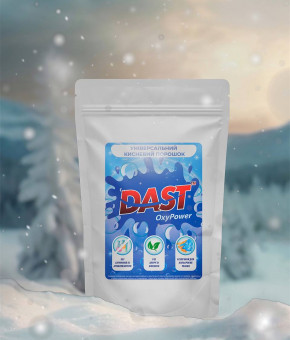
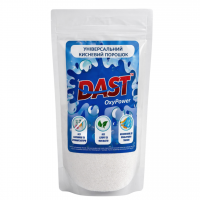
If you want to know how to clean a water cooler yourself at home, then for household use, where a milder but still effective product is needed, the Dast universal oxygen powder is a good choice. It works on the basis of sodium percarbonate, which releases active oxygen when dissolved in water. This action helps clean internal surfaces, remove organic contamination, and provide an additional disinfecting effect without using chlorine. Dast is suitable for soaking removable cooler parts, drip trays, and taps, does not leave a strong odor, and is convenient for regular use at home.
The choice of product depends on the operating conditions of the cooler, the intensity of use, and the required level of disinfection. After properly selected treatment, the equipment stays clean, and the water retains its taste and hygienic properties.
Cleaning and disinfecting a water cooler is an essential part of its operation. The use of questionable household remedies does not provide the required level of safety and may damage the equipment. It is much more effective to use proven professional products that work predictably and safely.
Regular cleaning of a water cooler extends its service life, preserves drinking water quality, and supports a responsible approach to hygiene, both at home and in commercial spaces.
Frequently Asked Questions (FAQ)
1. Can I limit maintenance to rinsing with water only, without disinfection?
Regular rinsing with water removes some visible contamination, but it does not solve the problem of biofilm inside the system components. That is why maintenance usually combines mechanical cleaning of removable parts with treatment using a suitable product according to the instructions.
2. Why does a cooler still get dirty even when bottled water is used?
Because microorganisms can get inside during bottle replacement, through contact with air, taps, and the drip tray, while biofilm gradually forms on surfaces that are constantly in contact with water.
3. How can I avoid odor or off-taste after treatment?
It is important to strictly follow the concentration and contact time, and then thoroughly rinse and flush the system with water as indicated in the product instructions. If the odor remains, it is better to repeat the treatment correctly or contact a service provider.
MDM Group Expert Comment:

Regular cleaning and disinfection of a water cooler help maintain water quality, hygiene, and reliable equipment performance. Household or homemade cleaning products do not provide consistent results and may damage certain parts of the system. The best solution is regular maintenance using specialized products that clean safely and help control microbiological risks.
Yana Holovenko, Head of Quality Department, MDM Group