

How to descale your coffee maker
Content
A huge number of people buy a coffee machine to enjoy an aromatic and invigorating drink. But not everyone thinks about the fact that this kind of appliance requires proper care. Some people don’t even read the manual fully, limiting themselves to brief instructions about how to make coffee. A breakdown of the coffee machine due to limescale can therefore become an unpleasant surprise. To prevent this, you need to pay attention to the regular maintenance of your appliance. And today we’ll find out how to descale a coffee machine.
THE MOST COMMON CAUSE OF COFFEE MACHINE MALFUNCTIONS
Even the best and most modern coffee machine, used only with high-quality water, will sooner or later signal the need for descaling. Simply dusting the appliance is absolutely not enough to avoid a breakdown. And using soft water is not a guarantee either. Sooner or later, limescale will still build up in the coffee machine. Of course, when using hard tap water, this happens much faster. But even proper use does not cancel the need for regular cleaning.
WHAT IS DESCALING AND WHY IT’S NECESSARY
The term “descaling” refers to the process of cleaning the coffee machine from accumulated limescale, which is formed from mineral salts (mainly calcium and magnesium). When heated, they break down, forming a solid deposit (which settles on the internal surfaces of the equipment) and carbon dioxide. It is the concentration of these salts that affects the characteristics of water — the more of them there are, the harder the water. That’s why for preparing coffee in a coffee machine it’s recommended to use soft water — for example, by installing a special filter on the water supply.
But even soft water will eventually lead to limescale build-up. It can change the taste of the coffee. And if you ignore its appearance, it can cause the appliance to break down.
HOW TO REMOVE LIMESCALE: HOME METHODS
Quite often, people recommend using citric acid to descale a coffee machine. You can buy it in any supermarket, and it costs next to nothing. During treatment, citric acid reacts chemically with the limescale (lime deposits), causing them to separate from the surfaces. But how exactly do you descale a coffee machine? The usual recommendations are:
-
remove any remaining coffee and grounds from the machine;
-
rinse the unit;
-
in a suitable container, dissolve 8 teaspoons of citric acid in 1 liter of warm water;
-
pour the resulting solution into the coffee machine’s water tank and leave it for 2–3 hours;
-
run the appliance through a coffee-making cycle; in case of heavy contamination you can repeat this several times;
-
drain the liquid and rinse the tank thoroughly;
-
fill it with clean water and run a “blank” coffee cycle to wash out any remaining citric acid.
It’s important to keep in mind that citric acid can have a negative effect on the internal components of the appliance, including its working parts. Its use can trigger corrosion processes. That’s why coffee machine manufacturers warn owners against such experiments and recommend using specially designed products for servicing this type of appliance.
You can also find other tips on the internet about how to descale a coffee maker at home. In particular, people suggest using Coca-Cola, vinegar and some other products. But they can be an even worse choice than citric acid. These liquids can damage the rubber seals and gaskets inside the coffee machine and cause other functional problems.
WHAT SHOULD YOU USE TO DESCALE A COFFEE MACHINE?
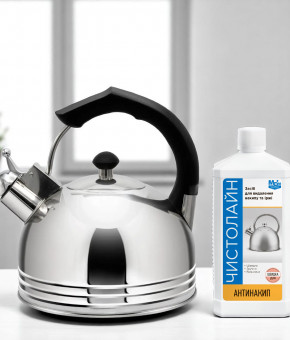
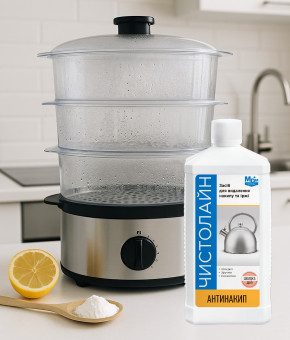
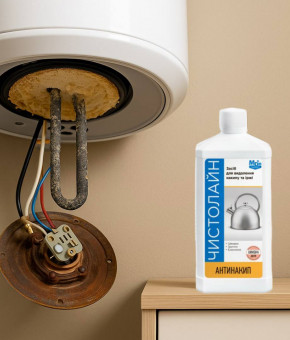
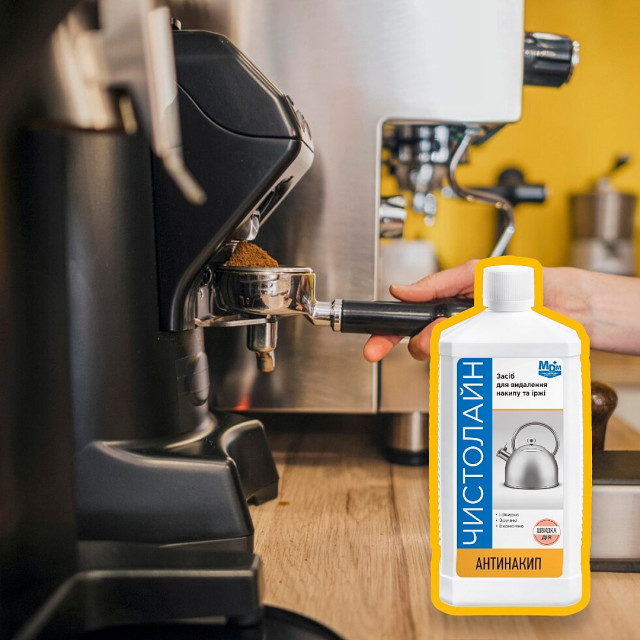
When choosing a descaling product for coffee machines, it’s best to look for specialized solutions. An excellent option is Chistoline Anti-Scale. This is a professional descaling liquid that quickly and effectively dissolves hard deposits and helps flush them out without damaging the appliance’s surfaces and internal mechanisms.
The composition of this product has been carefully designed to provide high-quality cleaning and protect the performance of household appliances. And it’s very easy to use — it is recommended to pour Chistoline Anti-Scale into the water tank and run several blank coffee-making cycles (the number of cycles depends on how dirty the machine is). Then you need to drain the liquid from the appliance and repeat the procedure several more times — this time with clean water. Make sure that the water coming out is clear and has no unpleasant odor.
The cleaning process should also include removing and washing all detachable parts, including filters and the drip tray. Usually it’s best to complete this step at the very beginning of the descaling process.
You should descale your coffee machine regularly, taking into account the manufacturer’s instructions and the characteristics of the water you use to make coffee.
Expert comment from MDM Group:

All company products undergo quality control and comply with current safety standards. We apply a multilevel testing system at every stage of production, including raw material assessment, finished formulas, and product stability. MDM Group continuously improves formulations and production technologies to ensure consistent performance both for household and professional use. We pay special attention to efficiency and safe application on different surfaces, in accordance with Ukrainian and international standards.
Yana Holovenko, Head of Quality Department, MDM Group